Twelve Is the Magic Number: The Psychology, Pricing, and Social Pull Behind America's Donut Dozen
You walk in planning to grab one donut. Maybe two. You walk out holding a pink box. Sound familiar?
If you've ever stood at a donut counter and felt the gentle gravitational pull toward the dozen — even when you absolutely did not need twelve donuts — you're not alone. And you're not weak-willed. You're just human. The donut dozen is one of the most quietly effective retail conventions in American food culture, and it didn't get that way by accident.
Why Twelve? The Number That Stuck
The dozen as a unit of sale predates donuts by centuries. Eggs, roses, bagels — twelve has been a commercial staple for so long that most people never think to question it. For donuts specifically, the convention got cemented in the mid-20th century as chains scaled up and needed a standardized box size that made production, packaging, and pricing efficient.
But here's the thing: efficient for the shop doesn't automatically mean irresistible for the customer. That part took a little more engineering.
"The dozen works because it sits right at the edge of what feels indulgent but not wasteful," says Dr. Priya Nair, a consumer behavior researcher who studies food purchasing patterns. "Six feels like you're holding back. Twenty-four feels excessive. Twelve hits this sweet spot where you feel like you're treating yourself and being practical at the same time."
That balance — indulgence with a side of rationalization — is basically the emotional engine behind every dozen sold in America.
The Price Gap That Closes the Deal
Walk into almost any donut shop and do the math. A single donut might run you $1.75 to $3.50 depending on where you are and how fancy the place is. A dozen? Usually somewhere between $14 and $22. On paper, you're paying less per donut when you buy twelve. In practice, you're spending significantly more total money.
But that per-unit discount is doing a lot of heavy lifting in the customer's brain.
"It's classic unit pricing psychology," says Marcus Ellwood, who owns a specialty donut shop in Columbus, Ohio. "People anchor to the per-donut cost, not the total. When they see they're saving fifty cents a donut by going to a dozen, they feel smart. They're not thinking about whether they actually need twelve donuts — they're thinking about the deal."
Ellwood says his shop sees the dozen as the single most important item on the menu from a revenue standpoint. "We sell a lot of singles and half-dozens, but the dozen is where the margin lives. It's where the volume lives. Everything else is kind of a gateway to it."
That gateway mentality is intentional. Many shops price singles and half-dozens in a way that makes the dozen feel like an obvious upgrade — not a splurge, but a logical next step.
Social Sharing Made the Dozen a Cultural Unit
Here's something that's changed in the last decade: the dozen stopped being just a personal purchase and became a social one.
Bring a box of donuts to the office, to a friend's house, to a Saturday morning soccer game, and you're a hero. The dozen scaled perfectly with America's shift toward communal food experiences. It's enough for a small group. It's visually abundant. It photographs beautifully. And it signals generosity without requiring the kind of effort that, say, baking something from scratch would demand.
"Donuts became the universal bring-to-a-crowd food," says food culture writer Janelle Tran. "And the dozen is the right size for that. It's not a single serving — it's a statement. 'I thought about you people. I went to the donut shop.'"
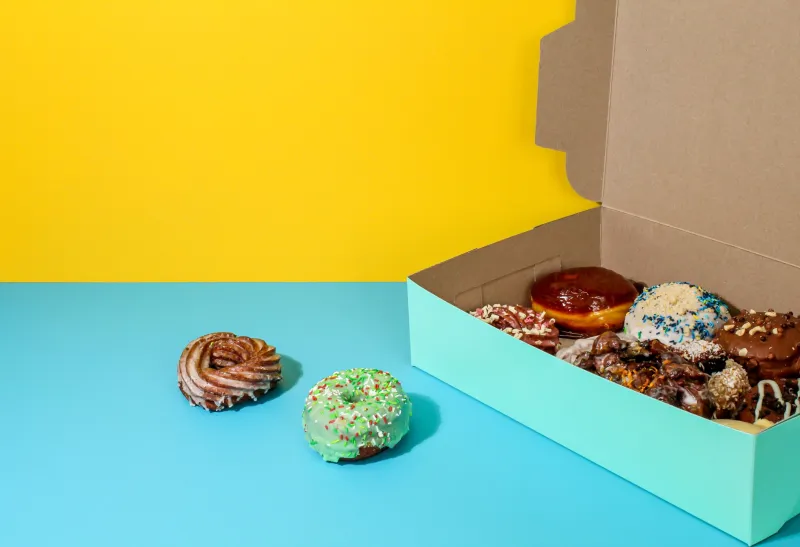
That social dimension got amplified by Instagram and TikTok. An open box of twelve carefully arranged specialty donuts is practically engineered for content. Shops started leaning into this, designing boxes that open flat for overhead shots, creating color-varied assortments that pop on screen, and even offering curated dozen options with names and themes.
The dozen didn't just become a purchase. It became shareable content — which means every box is also free advertising.
What Happens Inside Your Head at the Counter
Behavioral economists have a term for the moment when a customer's original intent (one donut) gets overridden by a combination of pricing cues, social context, and environmental nudges: "decision override." It's not manipulation exactly — it's more like a series of nudges that all point in the same direction.
At a donut counter, those nudges stack up fast. The visual display shows donuts in rows of twelve. The pricing board lists the dozen prominently. The staff often asks "just getting a box today?" as a default framing. The pink box is already sitting there, open and ready.
"There's almost no friction in the path toward a dozen," says Dr. Nair. "And friction is what stops people from upgrading. Remove the friction, make the value case obvious, add a social justification — 'I can share these' — and the single purchase almost doesn't stand a chance."
For customers, the post-purchase rationalization comes easy. You can freeze them. You can share them at work Monday. You deserve a treat week. The dozen practically comes with its own built-in excuse kit.
How Craft Shops Are Rewriting the Formula
The rise of specialty and artisan donut shops has introduced some interesting tension into the dozen model. When a single donut costs $4.50 or $5, a dozen tips north of $50 in some markets. That's a harder sell — and it's pushed some shops to rethink their unit structure.
Half-dozens, curated four-packs, and "build your own" boxes with minimums of six have all emerged as alternatives. Some shops have leaned into smaller quantities as a luxury signal: "You don't need twelve of these. You need four of the best ones."
But even among premium shops, the dozen hasn't disappeared. It's just gotten dressier. Custom boxes, branded tissue paper, mix-and-match menus — the dozen got an upgrade to match the price point.
"We sell a lot of half-dozens," admits Ellwood, "but on weekends, the full dozen still dominates. People want the abundance. They want to feel like they got a real haul. That feeling doesn't go away just because the donuts got fancier."
The Dozen Isn't Going Anywhere
For all the innovation happening in donut culture right now — seasonal flavors, regional ingredients, elaborate toppings, online ordering — the dozen remains the stable commercial center of gravity. It's a convention that happens to be backed by solid psychology, pricing logic, and a social media ecosystem that rewards abundance and generosity.
So next time you walk in for one and leave with twelve, don't be too hard on yourself. You didn't lose a battle with self-control. You just ran straight into one of the most well-designed retail experiences in American food culture.
At least the donuts are good.