Why Your City Never Got the Good Donuts: The Geography of Flavor That's Leaving Half of America Behind
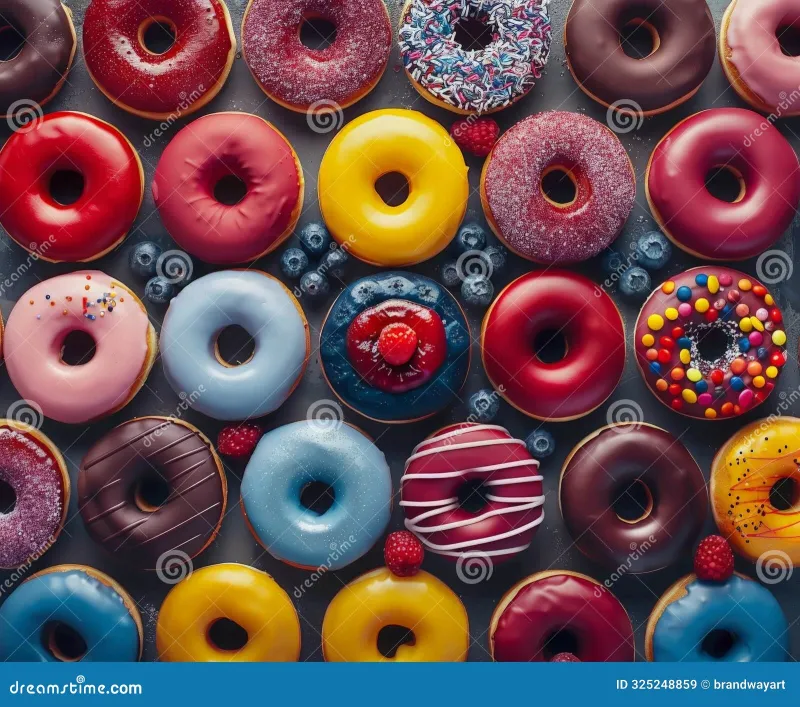
Photo: colorful specialty donuts with unique exotic glazes and toppings flatlay, via thumbs.dreamstime.com
If you live in certain parts of Los Angeles, you've probably eaten an ube-glazed donut so good it made you briefly reconsider your entire relationship with food. If you live in Phoenix, you may have never seen one in person.
If you're in Portland, Oregon, a bacon-maple bar is practically a civic institution. In Indianapolis, it's still a novelty that gets described as "weird" by people who haven't tried it.
This is the donut gap — the strange, frustrating, and surprisingly revealing divide between the flavors that thrive in specific American cities and the ones that never seem to travel. And the more you dig into why it exists, the more it tells you about how American taste actually works.
The Innovation Clusters
Flavor innovation in the American donut world doesn't happen evenly. It tends to concentrate in a handful of cities — Portland, Los Angeles, New York, Chicago, Austin, and a few others — where a combination of factors creates the right conditions for culinary risk-taking.
Demographic diversity plays a huge role. Los Angeles's ube moment didn't happen in a vacuum — it grew directly from the city's large Filipino American community and a broader embrace of Southeast Asian flavors that had been building for years in the restaurant scene before it hit the donut shops.
"Flavor adoption follows community," says Dr. Anita Chowdhury, a food anthropologist who has studied regional taste preferences across the US. "When a flavor is already familiar to a significant portion of a local population, a bakery taking a risk on it isn't really taking a risk at all. They're serving something their customers already love."
This is why miso caramel donuts became a quiet hit in San Francisco's Mission District before most of the country had considered the combination. It's why cardamom-rose glazes found a foothold in Minneapolis, home to one of the largest Somali communities in America. The flavor wasn't exotic to the people eating it — it was nostalgic.
Why the Good Stuff Stays Put
So why don't these flavors spread? The answer involves a mix of supply chain realities, franchising economics, and what food distributors delicately call "regional risk tolerance."
Small craft bakeries are the primary incubators of innovative donut flavors. But by definition, they're small. They source ingredients locally, often from farmers and specialty suppliers they've built relationships with over years. Ube paste from a specific Filipino grocery importer in Cerritos isn't something a bakery in Omaha can easily replicate — at least not without significant effort and cost.
"We use a butterfly pea flower extract from a supplier we found at a farmers market," says Jake Ohlendorf, who runs a specialty donut operation in Austin. "It gives our glaze this incredible color that shifts depending on the acidity. I could not tell you how to source that in most American cities. I barely know how I source it here."
For chain operations, the calculus is different and arguably more damaging to flavor diversity. National chains require ingredients that can be sourced consistently at scale, prepared with minimal training variation, and accepted by a broad consumer base across wildly different markets. The result is a gravitational pull toward the lowest common denominator — flavors that offend no one and excite no one.
"The chains aren't dumb," says food industry consultant Rachel Blum, who has worked with several national bakery brands. "They know their glazed and their chocolate frosted sell everywhere. An ube donut might absolutely crush in three markets and bomb in fifteen others. From a distribution standpoint, that's not a product — that's a problem."
The Mediocrity Pipeline
While innovative flavors stay local, a different kind of donut travels extremely well: the adequately inoffensive one. Vanilla frosted with rainbow sprinkles. Chocolate glazed. Powdered sugar. These are the flavors that dominate chain display cases from Maine to New Mexico, not because Americans love them most, but because they're the safest possible bet for a business model built on scale.
The irony is that this dynamic actively suppresses consumer demand for better options. People in markets with limited craft donut access often don't know what they're missing — not out of indifference, but because they've never had the reference point.
"I grew up in a small town in Kansas," says Demi Reyes, now a pastry chef in Chicago. "I thought I didn't like donuts. Turns out I just didn't like the donuts I had access to. The first time I had a properly made, fresh, craft donut, it was genuinely a different food."
The Slow Spread
There are signs that the donut gap is beginning to close, if slowly. Social media has accelerated flavor awareness in ways that used to take years. A donut that goes viral from a shop in Seattle creates demand — and sometimes inspires imitation — in cities that would previously have taken a decade to catch on.
A few ambitious craft bakers have started shipping specialty donuts nationally, though the logistics of keeping fried dough fresh across time zones remain a real obstacle. Others are licensing their recipes or opening second locations in markets they've identified as underserved.
But the most powerful force closing the gap might simply be migration. As Americans move between cities for work and cost of living, they carry their food expectations with them. Someone who spent three years eating exceptional donuts in Portland isn't going to be satisfied with a chain glazed when they relocate to Charlotte. They'll look for something better — and sometimes, they'll open it themselves.
What the Gap Reveals
The donut flavor divide isn't just about donuts. It's a snapshot of how American food culture actually diffuses — through community, through demographics, through the courage (or lack thereof) of individual business owners willing to bet on something unfamiliar.
The cities with the most vibrant donut scenes are almost always the ones with the most diverse populations, the most robust local food ecosystems, and the most customers willing to try something they've never heard of before.
That's not a coincidence. And understanding it might be the first step toward getting better donuts wherever you happen to live.
In the meantime, if you want the good stuff, you might have to travel for it. Which, honestly, is not the worst excuse for a road trip.